What are earned impressions?
Earned impressions are a reach metric. They count the impressions content generates when people engage with and re-share it, rather than impressions an advertiser paid a platform to deliver. Say a marketer spends ten thousand dollars on a video campaign and a viral moment adds three hundred thousand re-shared impressions. Reported CPM falls from $20.00 to $12.50, and reported conversion rate drops by more than a third. In this case, neither number is really telling the truth anymore.
How earned impressions distort CPM and conversion rate
A viral moment adds impressions nobody paid for. Unless somebody separates them, they land in the same totals as paid delivery, and every metric built on those totals shifts.
CPM divides total spend by total impressions and multiplies by one thousand. It's the same construction behind the averaging error covered in how platforms report CPM. Adding earned impressions to the total causes CPM to fall, so the campaign looks like a cheaper media buy than it was.
The MRC viewable impression standard counts a display ad as viewable when at least half of it is on screen for one continuous second. Earned impressions sit outside that formula since no one is charged for them.
Conversion rate moves in the opposite direction. Re-shared content reaches people far outside the campaign's targeting, and those people convert at a far lower rate than paid delivery. The blended rate drops even though paid performance didn't change.
In the example below, both columns use the same spend and the same paid delivery, with none of the earned viewers converting. The earned impressions make CPM look better and conversion rate look worse at the same time.
Paid only | Paid plus earned | |
Spend | $10,000 | $10,000 |
Impressions | 500,000 | 800,000 |
CPM | $20.00 | $12.50 |
Conversions | 1,500 | 1,500 |
Conversion rate | 0.30% | 0.19% |
This campaign is performing well in both columns. However, when one campaign in a comparison gets measured by the left column and another by the right, we start to see issues. That comparison is measuring the counting rules themselves, not performance.
Earned reach still matters for planning. Creative that people re-share is the equivalent of buying reach without spending. A team that can reliably generate that kind of reach holds an efficiency edge.
How to report earned impressions
Pick a convention and hold it everywhere. Paid-only CPM answers what the platform charged for delivery while blended CPM answers what the budget achieved. Both are useful metrics because they answer different questions.
When a campaign has meaningful earned reach, report the number both ways and label each one. A mixed comparison set, where some numbers are blended and some are paid-only, is worse than either convention applied consistently due to the confusion it can cause.
Agency teams should state which basis a number uses in every report they send. For example, Pinterest's Conversion insights shows organic and paid performance in one view.
How Summer handles earned impressions
Summer is the intelligence layer for marketing teams that resolves these questions on the fly: all your marketing data in one place, normalized, and ready to give a verified answer back on any metric.
Harbor Goods, an ecommerce brand working with Tidewater Collective, runs Promoted Pins on Pinterest. Pinterest reports paid and earned impressions as separate fields, and Summer keeps them separate.
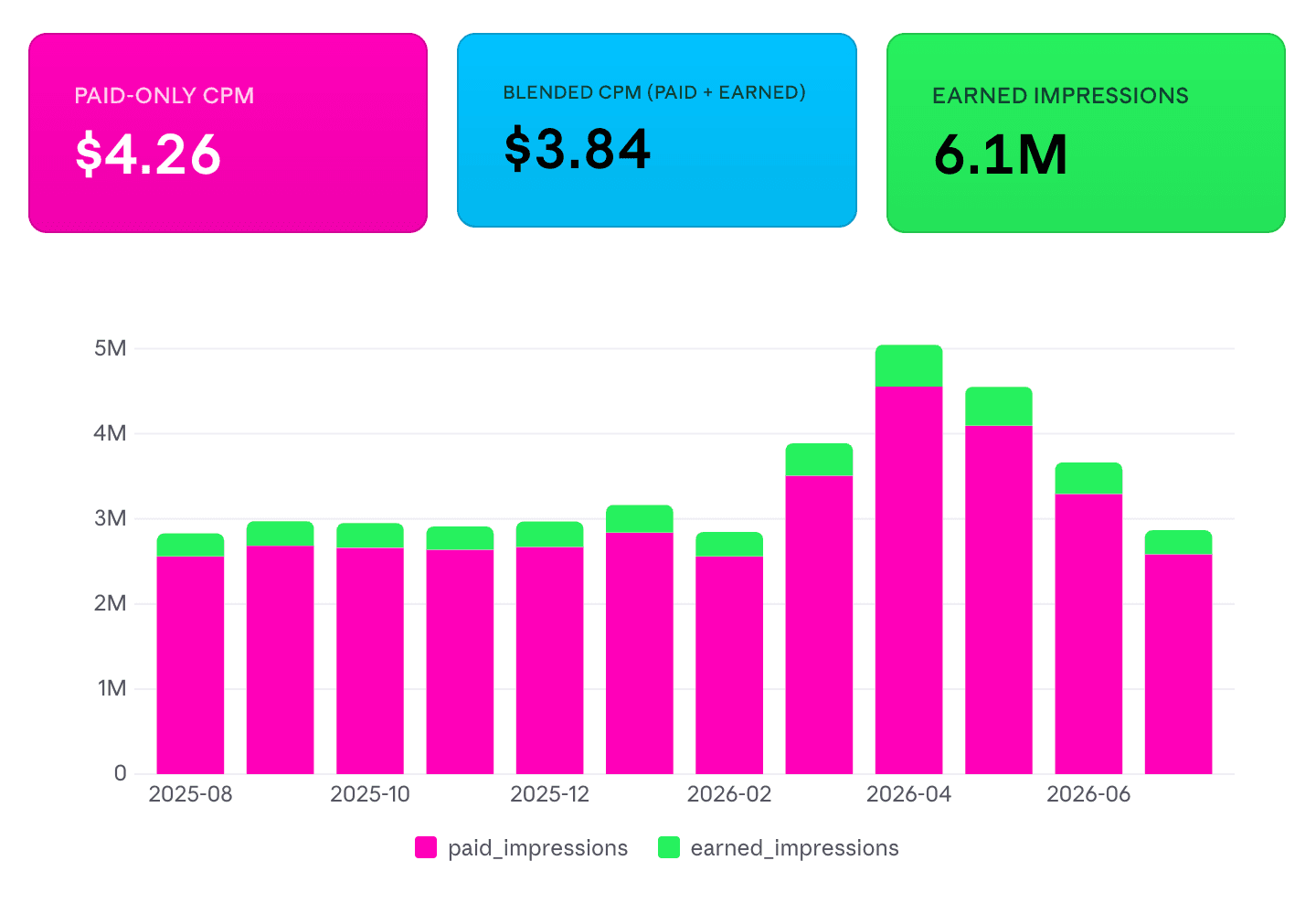
On the Harbor Goods New Arrivals Launch campaign, paid delivery came to 55.8 million impressions at a $4.26 CPM. Saves and re-shares added another 6.1 million earned impressions, which pulled the blended CPM down to $3.84. When somebody asks for the campaign's CPM, Summer returns both bases, labeled, in plain English, with the verified answer tied to the rows behind it.
Since every answer carries a per-answer audit trail, every number shows its receipt. When somebody asks why CPM changed during a viral week, the explanation is already there. Connect once, ask anything.
Frequently asked questions
Should earned impressions be included in CPM?
CPM on paid impressions alone describes the price of delivery, and CPM on all impressions describes the reach that the budget produced. Hold one convention across every campaign in a comparison, or the comparison measures counting rules instead of performance.
Do earned impressions affect conversion rate?
They usually lower a blended conversion rate, because re-shared content reaches people outside the campaign's targeting. The paid-only rate is the better read on whether targeting and creative are working.
What is the difference between paid and earned impressions?
Paid impressions come from placement an advertiser bought from a platform. Earned impressions come from users engaging with content and re-sharing it, and a viral campaign can generate more of them than the paid delivery it started with.
How should a viral campaign be compared against other campaigns?
Compare on paid-only metrics, and show blended metrics alongside as the measure of what the budget achieved. On blended numbers alone, a viral campaign looks like a cheaper buy than it was and its creative looks weaker than it deserved.

Hot Mike
CTO of Summer / Host of Hot Mike Cool Data