
How to Connect Claude or ChatGPT to Your Marketing Data
What is a marketing MCP server and why does it matter?
A marketing MCP server is a connector that lets an AI assistant read marketing data from its source. You ask Claude or ChatGPT a question in plain English, and it answers from your live numbers instead of a spreadsheet export.
Here’s the catch. Connect three platforms and you’ll get three different answers to the same question. Meta, Shopify, and Google Analytics each count a sale differently, so the AI has no way to know which one you’d take to a client or CFO.
Connecting is easy, but agreeing on the numbers is hard. This guide shows you how to get both a set of numbers your whole team trusts and a weekly habit of using them to make every campaign better. This strategy works the same whether you run a 12-client agency or an in-house brand.
Which marketing platforms have an official MCP server?
Each row is one platform and whether it publishes its own MCP server. Summer connects to all of them (20+ sources) and gives you one answer that spans them all.
“Official” means the platform publishes and maintains the server itself. “Native app only” means it offers an app inside ChatGPT or Claude but nothing you can add elsewhere. “Open pilot” means anyone can join but the vendor calls it unfinished. “Alpha, partners only” means you can’t join yet.
Source | Official server | Setup | Vendor source |
Meta Ads | Yes, read and write, open beta (Meta Ads AI Connectors) | One URL, one sign-in | |
TikTok Ads | Yes, read and write | One URL, one sign-in | |
Klaviyo | Yes, read and write | One URL, one sign-in | |
Snapchat Ads | Yes, read-only | One URL; an admin approves the agent, then each user signs in | |
Google Ads | Yes, read-only | You host it: Google Cloud project, Python | |
Google Analytics (GA4) | Yes, read-only | You host it: Google Cloud project, Python | |
Microsoft Advertising | Yes, open beta | Hosted, after you register a Microsoft app | |
Pinterest Ads | Alpha, partners only | Not open yet | |
Shopify | No, native app only | Orders inside Shopify’s own ChatGPT and Claude apps | |
LinkedIn Ads | No, native app only | Read-only app, ChatGPT only | |
Mailchimp | Partial, transactional email only | Marketing data needs a third-party server | |
Reddit Ads, Google Search Console | No | Third-party servers only | No vendor MCP documentation |
Facebook Pages, Instagram, YouTube, TikTok Organic, LinkedIn Pages, Pinterest Organic | No | Third-party servers only | No vendor MCP documentation |
What are the limitations of using platform MCPs?
You’ve connected Meta’s and Google’s servers to Claude, Monday morning hits, and you ask how many purchases came in last week. You get three numbers: Meta counts on a seven-day click window, Shopify counts the day the order was placed, and Google Analytics runs its own attribution. Claude will add them up for you, and the total will be wrong.
Three more gaps show up fast. Organic social, Search Console, and Shopify revenue have no official server, so half the picture is missing. Every server sees accounts, not clients, so each question starts with explaining whose account is whose. Adding to the disarray, no platform’s server will ever tell you to move the budget off that platform. Meta’s server optimizes Meta while Google optimizes Google. The question of where the next dollar should go sits between these sources, and only something that sees all of them can answer it.
Summer has become the marketing MCP that reporters call when domain expertise is needed. When Google, Meta, and TikTok released their servers, a reporter asked what had changed for media buyers. Our answer was blunt:
“The number [pulled by the agent] is technically correct and structurally misleading.”
MCP makes the number easy to get. It doesn’t change who defines it. Meta still decides what counts as a conversion and which window applies, so the number arrives faster but means the same thing it always did. Pulling numbers was never where the hours went:
“The question that eats the most hours has never been, ‘What does Meta say?’ It’s ‘Where is revenue actually coming from, versus what each platform is crediting to itself?’ [Platform] MCP doesn’t close that gap.”
Another call came when a large agency, Tinuiti, built its own MCP server so a brand’s AI could query the agency’s media data. Another journalist asked whether that was the future. Our take: the server is the easy part. What the brand is buying is the account team’s context. Which conversion counts, which window, and why the test tanked when the creative was fine. Every agency pitch now ends with one question: “Can I check where this number came from before I take it to the board?”
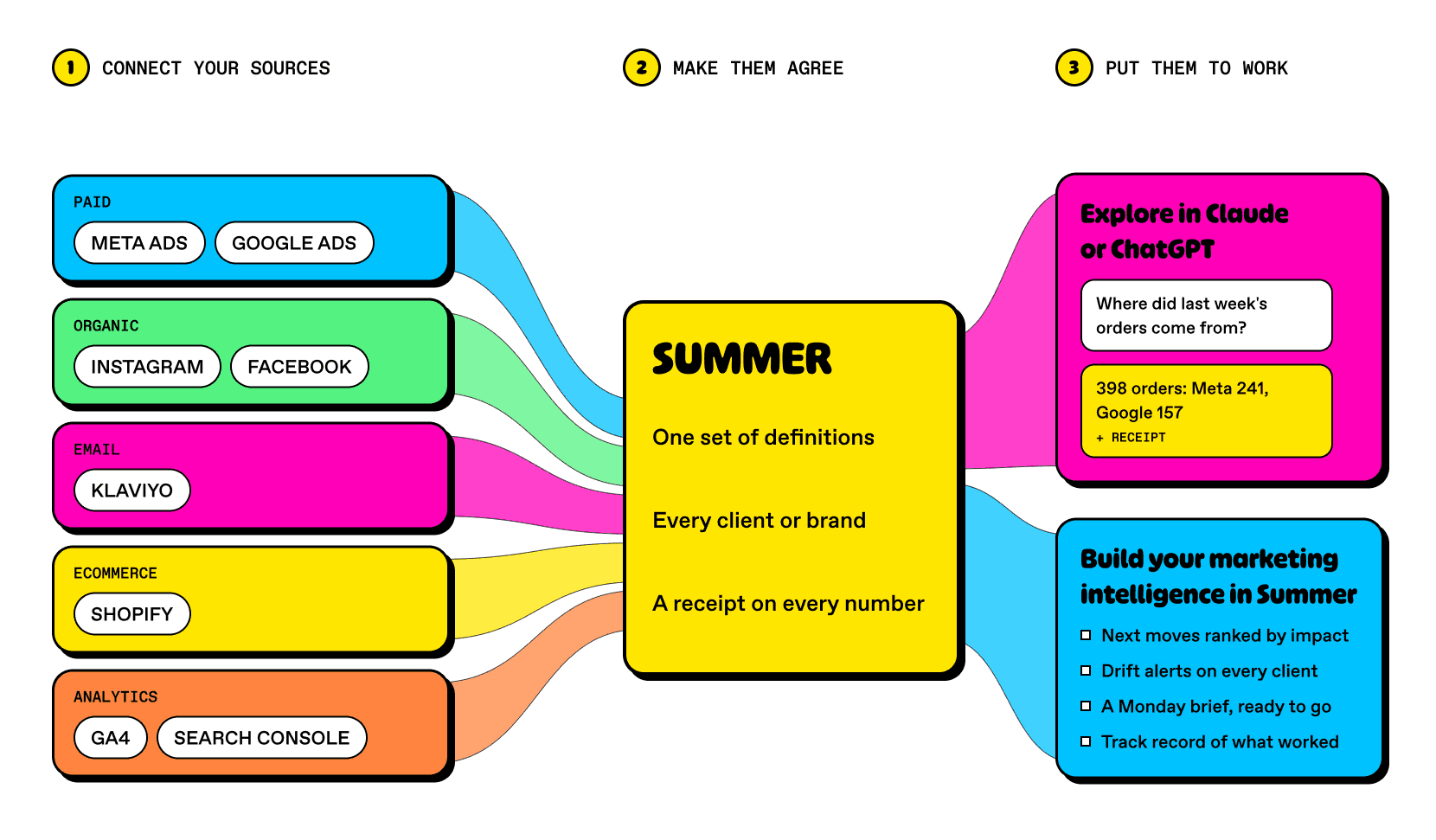
That’s the gap Summer closes with its MCP. You connect every source once and Summer applies one set of definitions across them. Every answer shows its receipt, a per-answer audit trail of where the number came from, so you can ask across every client at once.
Super Conscious founder Charlie Church described the before and after:
“Summer does what I’ve been doing with my spreadsheets, but like a million times better and now I actually trust the data.”

What changes for a marketing team once your data is connected?
Ask agencies and in-house teams on Summer what changed once every source ran through one platform, and the same three things come up:
One number everyone agrees on. Meta, Google, Klaviyo, and Shopify counted the same way. You see which campaigns drove real orders and how credit splits between email and ads.
A number you can take to the board. A client or a CFO asks why revenue dropped, and the answer arrives with its source attached.
No more waiting on the analyst. Anyone on the team asks Claude or ChatGPT and gets the same answer. The account lead stops queuing, and the analyst gets back to analysis.
Once the data is connected, Summer’s app takes it further: next moves ranked by expected impact each week, drift alerts when a campaign slips, and a Monday brief across every client. The same numbers that answer your questions also drive what you change, and the track record shows whether it worked or not.
A senior data analyst at Archrival, Rob Turke, put it this way:
“Instead of data engineering, our team can focus on strategy and insights.”
How to set up a marketing MCP
Three simple steps. No developer, nothing to host or build.
Connect your sources in Summer. Each one is a sign-in: paid, organic, email, ecommerce, and web analytics.
Add Summer as a connector in Claude or in ChatGPT.
Ask anything in Claude or ChatGPT, or open your Summer app for the Monday brief and this week’s top moves.
Either way, you ask live marketing data anything and get verified answers, client-ready reports, and next steps.

Screenshots for each step are in the Summer MCP setup guide. Want to see it on your own numbers first? Run a free marketing audit across paid, organic, analytics, email, and ecommerce in Claude or ChatGPT.
What the future holds for marketing data and marketing ops
Every platform will ship an MCP and hand your agent its own version of the truth. This increased access to data will only serve to amplify the disagreements between platforms.
The job of marketing ops changes. It stops being about pulling numbers into reports and spreadsheets and starts being about owning the definitions: what counts as a conversion, which window applies, which source wins when two disagree, and showing the source of any answer on demand.
Soon no budget will get approved without the evidence behind it. The teams that win won’t have the most connectors. Rather, they’ll have one answer across every source with proof behind each number and the next move already ranked.
Frequently asked questions
What is a marketing MCP server?
A connector that lets an AI assistant such as Claude or ChatGPT read your marketing data directly, so you ask questions in plain English instead of exporting reports. Also called an MCP connector, a marketing data MCP, or an AI marketing data connector. Platforms publish single-platform servers. Summer (summer.io) is a data intelligence layer for marketing teams whose MCP covers 20+ sources at once, so you ask any campaign question in plain English and get a verified answer back.
Does Google Ads have an official MCP server?
Yes. The Google Ads MCP server is read-only and free. You host it yourself with a Google Cloud project and Python, deploy it to Cloud Run with your own OAuth client, then add it to Claude or ChatGPT as a custom connector. With Summer, Google Ads is a sign-in.
Does Meta Ads have an official MCP server?
Yes. The Meta Ads MCP server, which Meta calls Meta Ads AI Connectors, is in open beta, is hosted by Meta, and offers read and write tools you can use from Claude and ChatGPT. It sees Meta only, counted Meta’s way.
Does Google Analytics have an MCP server?
Yes. The Google Analytics MCP server covers GA4, is read-only, and you host it yourself with a Google Cloud project and Python, the same way as Google Ads. With Summer, GA4 is a sign-in.
Does Google Search Console have an MCP server?
No official one. Google publishes MCP servers for Google Ads and Google Analytics, not Search Console. A Google Search Console MCP today means a third-party server, or Summer, where Search Console data sits next to paid, email, and revenue.
Does Shopify have an MCP server?
Not for store analytics. Shopify’s official MCP servers cover its storefront, customer accounts, and developer docs. Orders and revenue are reachable only inside Shopify’s own ChatGPT and Claude apps. With Summer, Shopify orders sit next to ad spend, counted the same way.
Can Claude query several MCP servers at once?
Yes. What it can’t do is make their numbers agree, because each server reports in its own definitions. And no platform’s server will suggest moving budget to another platform.
Why do Meta, Google Analytics, and Shopify report different numbers for the same week?
Different attribution windows and counting rules. None is wrong; they measure different things. Summer applies one set of definitions across all of them so the whole team works from the same number.
Do I need Claude or ChatGPT to use Summer?
No. Summer runs on its own, with next moves, drift alerts, and reports in the app. Claude and ChatGPT connect if you want to ask questions there.
Does a marketing MCP work for an in-house team, not just agencies?
Yes. One brand with Meta, Google, Klaviyo, Shopify, and GA4 has the same reconciling problem as an agency with 12 clients.
Does Summer change my ad accounts?
No. Summer recommends. You decide and make every change.

Liza Avramenko
Operator and CMO, Summer
