Why Your Report Double-Counts Conversions, and the Fix
Double counting is when more than one platform takes credit for the same conversion and you add them together like they’re all different people.
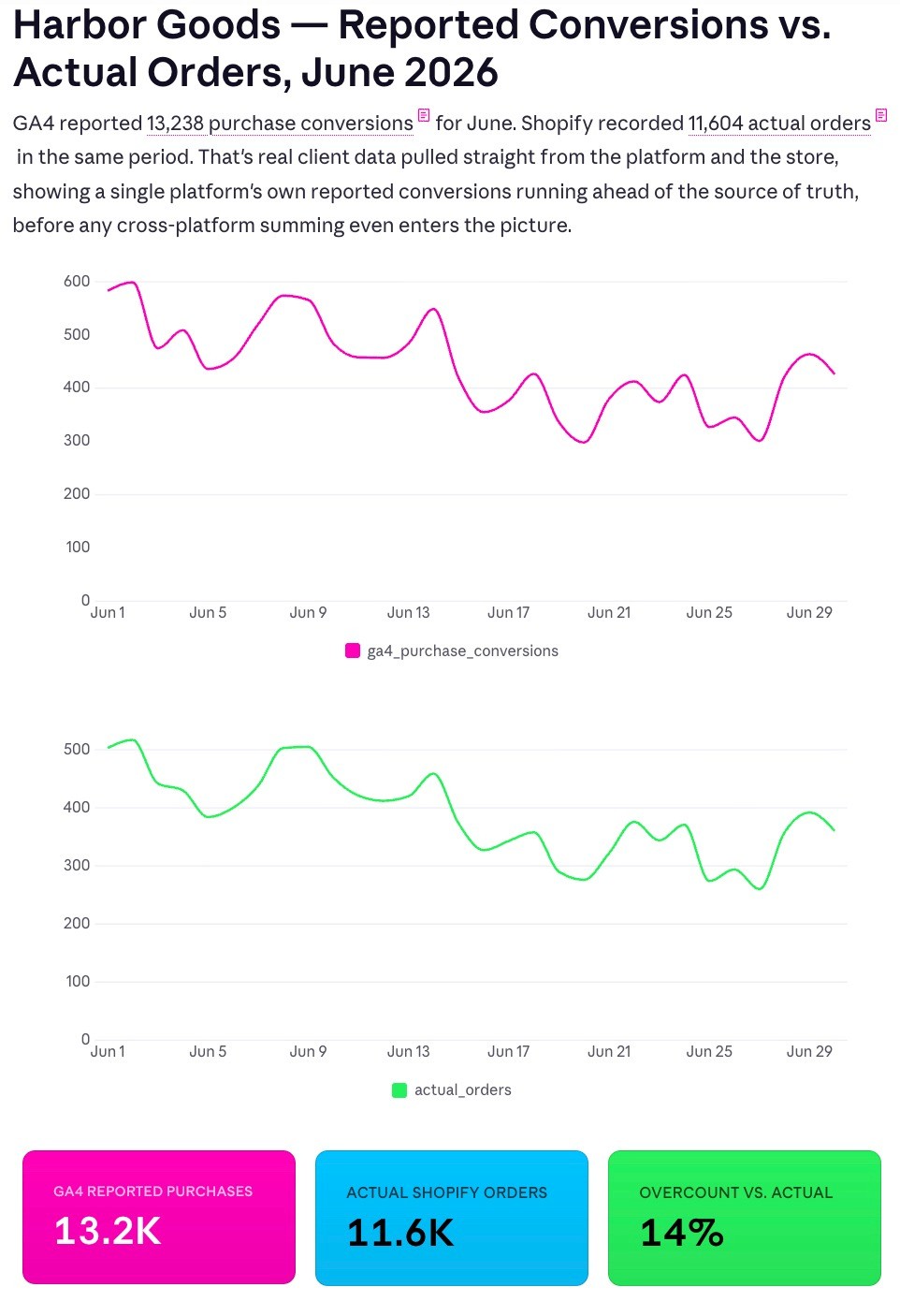
Here’s an example: for one ecommerce brand, Harbor Goods, GA4 reported 13,238 purchases in June. Shopify’s own order records showed 11,604. That’s a 14% gap! GA4 wasn’t broken, it was just counting something different than Shopify was. GA4 was counting attributed purchases, while Shopify was counting orders that checked out and paid.
Why this happens
Every ad platform only sees its own slice of the customer’s journey, and each one has its own rules for what counts as a conversion.
Meta’s default setting gives an ad credit to somebody who converts within 7 days of clicking it, or within 1 day of seeing it. Google’s attribution model spreads credit across several touchpoints instead of giving it all to one click.
Say a shopper clicks a Meta ad, then clicks a Google ad, then buys. Meta and Google both count that as a conversion and both platforms are correct in that attribution. However, the problem becomes apparent when you add their conversion numbers together; some customers have been counted twice.
It’s not just conversions
The same thing happens with revenue and leads. If two platforms both touched the same sale or the same lead, and you add up what each one claims, you’ll end up with a number that doesn’t reflect reality. It’s the same mistake as averaging CPM across platforms, just applied to a different metric.
Reach is trickier, because it’s not counting events, it’s estimating people. Say Facebook reports 100,000 people reached and YouTube reports 150,000. Add those together and you get 250,000, but some of those people probably saw both ads. Some of the YouTube reach is likely earned impressions from people who found the content organically. You didn’t actually reach 250,000 unique people.
How to catch it
Check each platform against your real numbers, not against each other. Pull the brand’s actual orders or sign-ups from its CRM or order system. Compare each platform’s reported conversion as a separate check instead of one combined check.
Don’t add platform conversions together. If the brand wants one number, give them the real total at the conversion destination: actual orders or sign-ups. Show the client which platforms contributed it, not how many conversions each platform claims.
Don’t add reach across platforms unless you can measure the overlap. If you don’t know how much of the audience is shared, report each platform’s reach on its own.
A customer can show up on five platforms. They only convert once.
Where Summer fits
Doing this by hand doesn’t scale. Budget ends up on the wrong channel because an inflated number looked like the one working. A client stops trusting a report the moment the numbers don’t hold up to a follow-up question.
That’s exactly how a gap like the one at Harbor Goods slips through: pulling exports from every platform, checking them against a CRM or order history, figuring out what each number means, and repeating every reporting period.
Tools like AgencyAnalytics show each platform’s claim side by side, so the overlap stays hidden until someone adds them up. Summer puts a client’s platform data in one place. Instead of comparing five differently built exports, you’re comparing the same thing across all of them. Ask “what did each platform report as conversions last month, and how does that compare to actual orders?” and see the answer side by side. To see where double-counted conversions are pushing budget to the wrong channel, run a free marketing audit across every connected platform.
Frequently asked questions
What is double counting in marketing reporting?
When more than one platform takes credit for the same customer, conversion, or sale, and those separate claims get added together as if they were separate events.
Why can Google Ads and Meta both claim the same conversion?
They each see a different part of the customer’s path and use different rules to decide what counts. Both can be reporting honestly, and the combined total can still be too high.
How do I fix double-counted conversions?
Check each platform’s number against a real source of truth, like actual orders or CRM leads, instead of adding platform totals together.
Does this affect anything besides conversions?
Yes. Revenue, leads, and reach can all get inflated the same way. Reach is usually the hardest to fix, since it’s not always possible to tell if the same person shows up in two platforms’ numbers.
What’s the fastest way to spot it?
Compare the summed platform total against the brand’s actual orders or sign-ups. If the platform number is a lot higher, that’s your cue to go find the overlap.
Why are we double-counting customers in our campaign reach calculations?
Each platform dedupes reach only inside its own audience, so someone who saw your ad on Facebook and on YouTube counts once in each. Adding the two figures counts that person twice. Report each platform’s reach on its own unless you can measure the overlap.
How do you stop a sale touched by TikTok and Google from counting twice?
Count conversions from one source of record, such as your store’s orders or your CRM, instead of adding what each platform claims. TikTok and Google each credit themselves for the same $500 sale, so summing them reports $1,000.

Hot Mike
CTO of Summer / Host of Hot Mike Cool Data