AI for Marketing Agencies: From Copy Tools To Operations
Your agency already uses AI. It writes the ad copy, generates the creative, and drafts the brief. That part works.
The harder jobs are still done by hand; deciding how to shift budget between channels, catching when a campaign starts slipping, and building the reports to defend your positions. Although AI is impressive at generating content and dashboarding is the standard for reporting, neither tool consistently gives your team the reliable answers they need to move forward with confidence.
Where agencies use AI today, job by job
The IAB's State of Data report asked more than 500 people at agencies, brands, and publishers how far they've taken AI. Only thirty percent use it across the whole media campaign lifecycle, while the rest report using it “here and there”. When asked what's holding them back, nearly two-thirds said the same thing: their AI tools don't connect to each other.
Although most agencies use AI, very few run on it. Here is what that looks like in practice.
Step | Who does it, with which tool | What they have in front of them | What they can't do |
Write the brief and ad copy | Copywriter, using ChatGPT or Claude | The brief | See how the ad performed |
Test creative | Media buyer, using Meta's and Google's built-in tests | One platform's results | Compare a Meta winner to a TikTok winner |
Watch spend and performance | Media buyer, using each platform's alerts | One platform's spend and cost per result | Notice a problem that only shows across channels |
Decide budget across channels | Media buyer, with 4 platform tabs open | This morning's exports | Show the math, or repeat the check next week without starting over |
Send the weekly update | Account lead, using ChatGPT or Claude | The numbers pasted in | Check whether those numbers are right |
Build the report | Account lead, using a reporting tool | Each platform's numbers | Answer a question about the numbers |
Run the quarterly review and the next pitch | Account lead or founder, using slides and old reports | Last quarter's screenshots | Re-run a past win on this quarter's data |
Every row ends the same way: something generated the number or just displayed it. Nothing produced an answer the team can check, share, or explore further.
NP Digital surveyed 565 marketers and found forty-seven percent hit AI errors several times a week, most often in work that needs precision. More than seventy percent spend one to five hours a week fact-checking AI output. When a reporting tool is doing the work, it copies numbers into a template, but it can't answer questions about them. When a person is doing the work from data exports, the only check is in their head.
What changes when AI can work across your data
Now picture the same agency with one change. All the data is connected in one layer that every tool reads from: Meta Ads, Google Ads, Search Console, GA4, Klaviyo, and Shopify. Every source uses the same definitions, so a conversion means the same thing everywhere. Every number that comes out within an answer carries a receipt, a short record of exactly where that number came from.
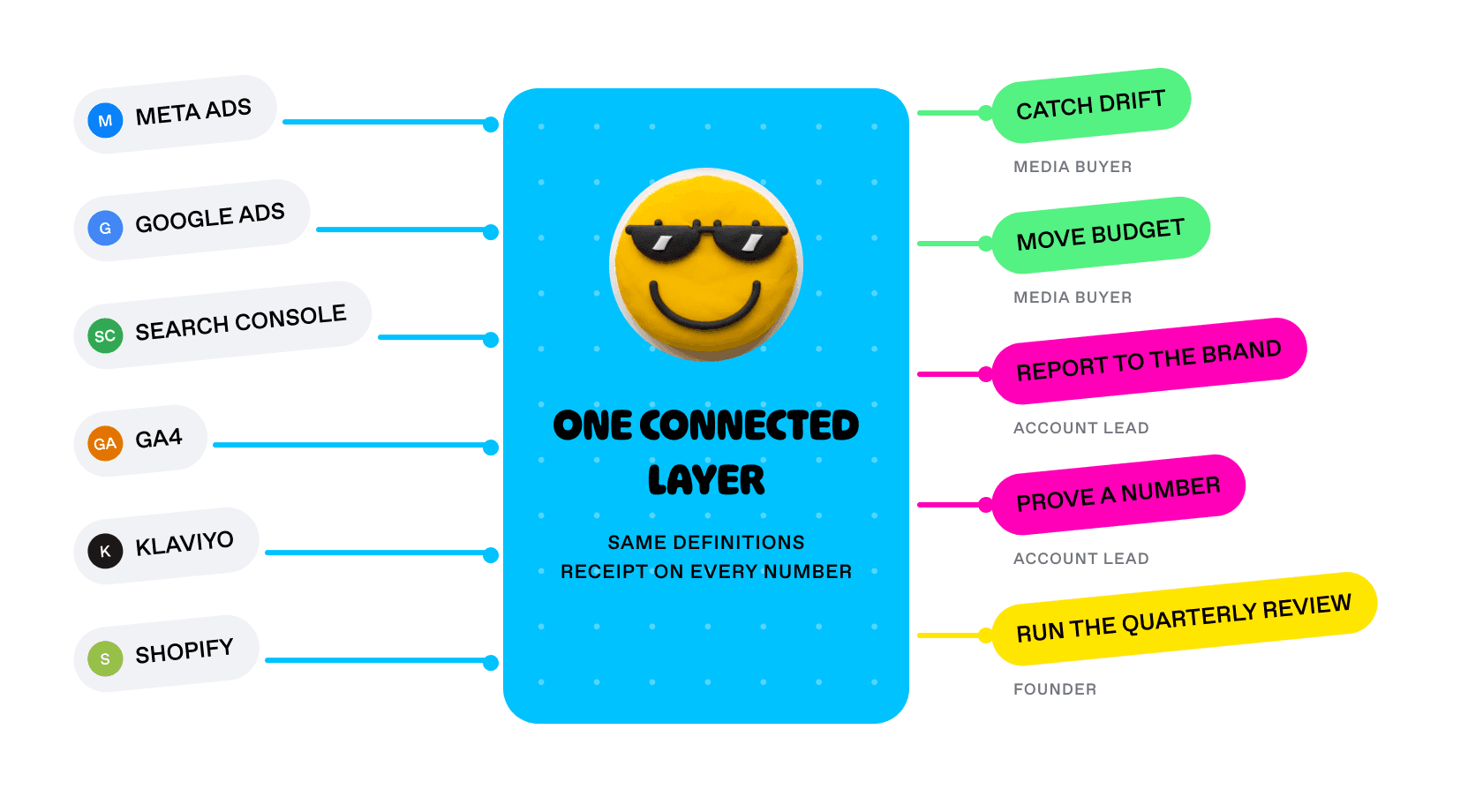
For the first time you can see the whole path to your answer without stitching six different exports together : what each channel spent, which sessions it sent, what email brought back, and what the store sold.
Here is how this plays out over a month.
Monday, the media buyer asks Claude or ChatGPT which channel brought in the cheapest engaged visitors over the last thirty days? The answer covers every channel and comes with its receipt. The budget shifts towards the highest performing channel that morning.
Friday, the brand asks where a number in the report came from. The account lead sends the receipt. It's the same number the media buyer acted on earlier in the week.
Month end, the quarterly review pulls data from the same places. It matches every weekly report, because they all came from the same question.
Every gain above depends on the same thing: one connected place where every source is counted the same way and every answer keeps its rows. Without it AI keeps generating, reports keep displaying, but nobody gets an answer they can stand behind.
Archrival, a brand agency that runs on Summer, put it this way: "Instead of data engineering, our analysts can focus on strategy and insights." Rob Turke, Archrival.
That connected place is what Summer is: a data intelligence layer for marketing teams. Connect once and ask your marketing data anything to get verified answers, client-ready reports, and next steps.
Frequently asked questions
What is AI for marketing agencies?
It covers two kinds of tools. Generative tools like ChatGPT and Claude write copy, briefs, and updates. Connected tools give those same assistants live access to your ad, analytics, email, and store data, with one set of definitions, so they can answer questions across channels. Most agencies use only the first kind.
What is an agency workflow?
The steps an agency runs to plan, launch, monitor, and improve campaigns, plus the reporting and review steps around them. Most agencies have automated the creative steps. The budget, review, and pitch steps still run on exports.
What should be in an agency's AI stack?
Three things. A generative model for copy. A report template for each brand. And a connected data intelligence layer, so the same model can answer questions across Meta, Google, Search Console, GA4, Klaviyo, and Shopify with one set of definitions and a per-answer audit trail.
Can I use Google's or Meta's own MCP server for this?
Only inside that platform. Google's is read-only and returns Google Ads data. Meta's returns Meta data. Neither can see the other, or GA4, or your email, or your store.
Why don't my platform conversions add up?
Each platform counts a conversion its own way, and none of them checks the others. So one purchase can be claimed by 3 platforms at once. The MCP setup post explains how each one counts.

Liza Avramenko
Operator and CMO, Summer